Complete private label guide
How private label candy works: from planning to production to the store shelf
Private label means a factory makes the candy and prints your brand on the bag. This guide follows the whole journey in order: planning your range, choosing shapes, bag size and design, production and lead time, shipping and import, and finally getting the product into stores and reordering. It includes a worked container calculation and a planner you can use to build your own range.
 By Rikard Kunsinsh, Candora TradingPublished October 8, 2026
124,416
bags in one 40ft container (example)
8–10 wks
first order lead time
4–6 wks
every repeat order
€12,600
one-off set-up per design (example)
What private label means in candy
You do not build a factory and you do not invent a recipe. You pick a proven product from a certified manufacturer, choose shapes and flavours, and the factory fills bags carrying your name, design and barcode. The factory owns production; you own the brand, the pricing and the customer. It is how retailers, distributors and online brands get an own-brand range with a margin a branded product cannot give them.
The catch is that packaging is printed to order. That one fact explains the minimum order, the one-off costs and why the first order takes longer than the rest.
Private label vs white label vs contract manufacturing
| White label | Private label | Own recipe (contract) | |
|---|---|---|---|
| Recipe | Factory standard | Factory standard, flavours adjustable | Yours, developed with the factory |
| Packaging | Generic or stickered | Your printed design | Your printed design |
| Shapes | Fixed | Choose from the mould library | Custom moulds |
| Minimums and cost | Lowest | One container per SKU | Highest |
| Time to market | Fastest | 8–10 weeks first order | Several months |
Before you contact a factory
ExamplePlan your range
Most private label problems come from decisions that should have been made before the first sample. Settle these six things first.
- 1
Who buys it and where
Pick one channel to start: supermarket, convenience, online, kiosk, gifting or pick & mix. The channel decides bag size, price point and design.
- 2
Which products
Jelly, sour, foam, licorice or gum, and any dietary requirement: vegan, gelatin-free, halal. Restrictions change which factory lines you can use.
- 3
How many SKUs
Each SKU needs at least one container. Three SKUs is a realistic launch; six is ambitious. More designs also mean more cylinders and film.
- 4
Budget
Set-up per design in the example is €12,600. Add the container cost, freight, duty, storage and marketing. A three-SKU 80g launch is roughly €239,355 before freight in this example.
- 5
Brand and trademark
Name, logo and a trademark check in your target market. Do this early; a rename after artwork approval means reprinting.
- 6
Target-market rules
Labelling language, nutrition panel format, allergen rules, importer of record. See the market table in the shipping section.
Choosing a factory
Ask every candidate the same questions and compare the answers in writing:
- Current food-safety certificates (BRCGS, IFS, ISO 22000, HACCP) and a copy of each, with expiry dates
- Halal, vegan or gelatin-free capability, if you need it, and the certificate that covers it
- Mould library and what a new mould costs
- Minimum order, minimum film purchase and how many SKUs can share a container
- Lead time for first and repeat orders, and what is counted from when
- Payment terms, deposit and what is refundable
- Whether you may use the same artwork and film at another factory later
Product development
ExampleShapes, bag size and design
Bag size
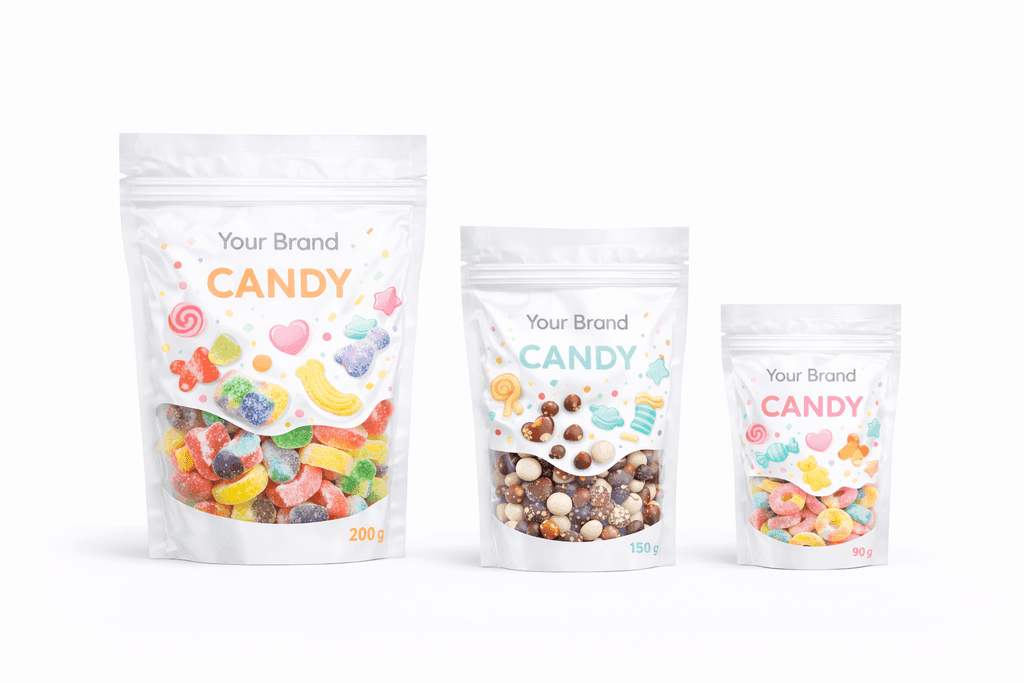
Bag size sets the price point, the number of shapes you can show and the channel. The same candy in a different bag is a different product on the shelf.
| Size | Role | Best channels | Shapes |
|---|---|---|---|
| 60g | Snack / impulse | Checkout, c-store, grab-and-go | Single shape or two; sour and novelty work well |
| 80g | Standard retail | Grocery, specialty and online shops | Up to 10 shapes: a true mix bag |
| 150g | Mid sharing | Gift, kiosk, tourist retail | A few shapes; common in own-brand ranges |
| 200g | Sharing / family | Grocery, online, gifting | 2 shapes: one or two hero shapes |
The worked example in this guide uses 80g and 200g. Other sizes are available on request and price differently.
Shapes
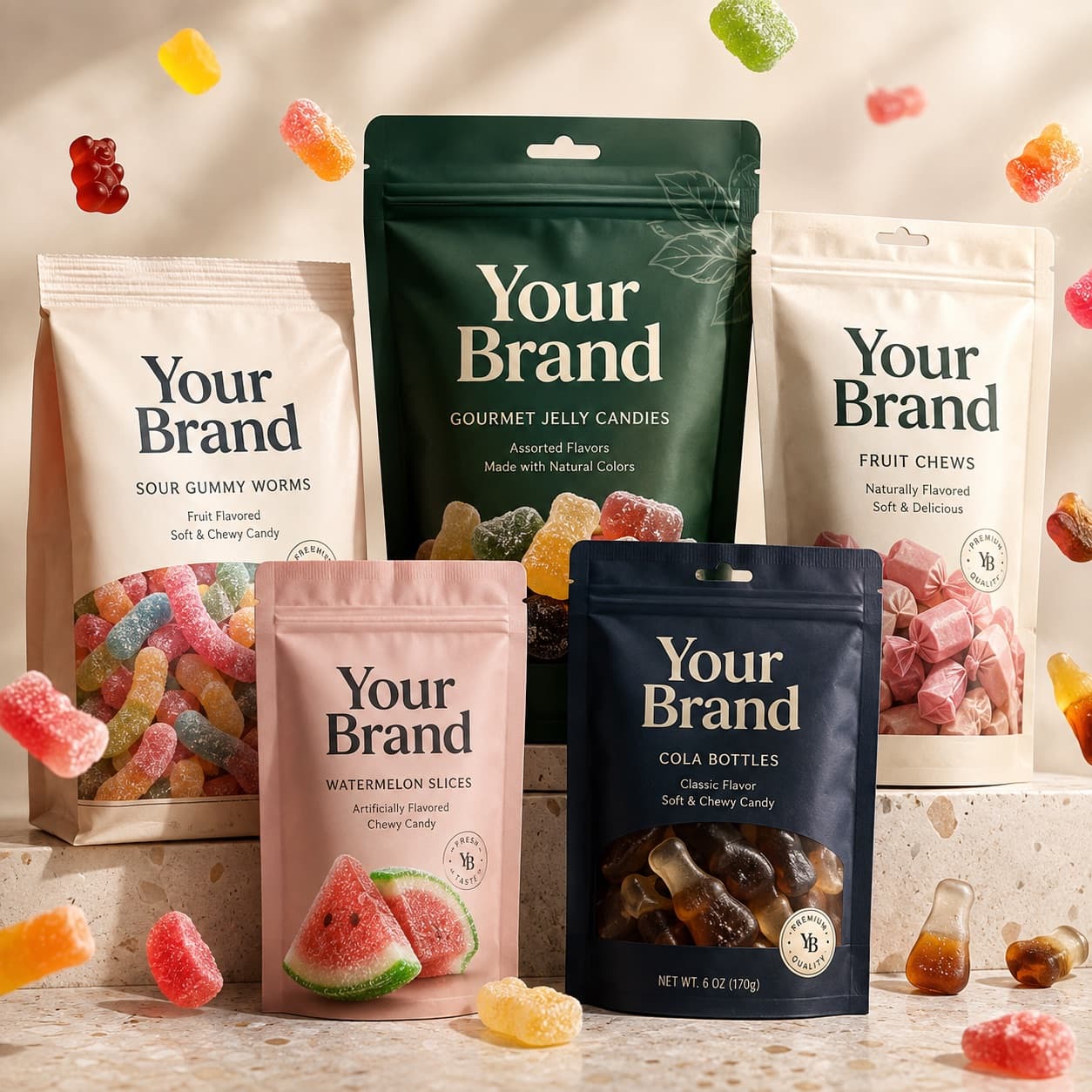
Shapes come from the factory's mould library, which in a typical jelly programme holds dozens of ready shapes: bears, bottles, worms, rings, hearts, fruit and novelty. Three rules keep it simple:
- Bag capacity: in the example an 80g bag carries up to 10 shapes and a 200g bag up to 2.
- Price is per bag, not per shape: choosing existing shapes does not change the price.
- Custom shapes need a new mould: about 10 days for delivery plus a mould cost, quoted separately. Shapes with fine detail (holes, faces) are most likely to need one.

Flavours and texture
Standard flavours (cola, strawberry, orange, apple, lemon, cherry, raspberry, pineapple, banana, watermelon) are the straightforward choice. Sour coating is possible on most shapes. A custom flavour normally needs 4–6 pallets in the order, and texture and thickness are tuned in sample rounds, so allow time.
Bag design and artwork
- Colours: each is a printing cylinder (€300). Up to 6 in the example. Fewer colours cost less and flat colour prints more reliably than photographic gradients.
- Template: the factory supplies it. It fixes seal areas, the window and where the barcode and nutrition panel sit.
- Mandatory content: ingredients, allergens, nutrition, net weight, best-before, importer address, barcode. Get these right before printing.
- One design or many: a full design per SKU gives the best shelf impact; one base design with flavour stickers saves film and cylinders.
- Proof: approve a printed proof, not only a screen file. Colours shift between screen and film.
Plan your own range
Step through bag size, shapes, design, volume and shelf economics. The planner uses the example prices from this guide, so the result is an estimate. Request a quotation to get real numbers.
Interactive planner
Plan your own range step by step. Figures use the example quotation on this page, so treat them as an estimate: real prices vary by shapes, volume, market and factory.
Choose bag size
80g suits impulse, c-store and multi-shape pick & mix bags. 200g suits sharing, grocery and online. Both are one container per SKU in this example (124,416 bags).
From approved brief to goods ready
ExampleProduction and lead time: 8–10 weeks, then 4–6
The first order is slower because your packaging does not exist yet: artwork has to be approved, cylinders engraved and film printed (30–45 days) before a single bag is filled. Once the film is at the factory, the next order only needs production time.
Factory lead time from approved artwork (first order) or confirmed order (repeat) to goods ready for pickup. Sea freight and customs are not included.
The seven steps
- 1
Brief and product choice
Week 0You choose format (jelly, sour, licorice, gum), bag weight and how many shapes go in each bag. The factory confirms which moulds already exist. A shape that is not in the mould library needs a new mould; delivery of a new mould is about 10 days, plus a mould cost quoted separately.
- 2
Samples and recipe approval
Weeks 0–3The factory produces samples in your flavours and texture. Standard flavours (cola, strawberry, orange, apple, lemon, cherry and similar) are the easy route. A custom flavour usually needs 4–6 pallets in the order. Plan for one or two sample rounds; feedback on thickness or texture goes to the factory's R&D team and takes days, not hours.
- 3
Packaging design and artwork
Weeks 1–4You send artwork in the factory's template. The packaging supplier returns a proof. Every print colour needs its own cylinder, so the number of colours drives the one-off cost. Using stickers to separate flavours on one base design avoids a new cylinder set per flavour.
- 4
Printed film and cylinders
30–45 daysYour plastic film is printed to order. The packaging minimum is 2 tonnes of film per design, enough for roughly 1.35 million 80g bags or 930,000 200g bags. This is the main reason a first order takes longer than every order after it.
- 5
Production and packing
Weeks 7–9Candy is cooked, moulded, cured, filled into your bags and packed in cartons on pallets. The factory should hold current food-safety certification (for example BRCGS or IFS) and every batch should be traceable.
- 6
Quality control and documents
Final weekPre-shipment checks, then the paperwork: commercial invoice, packing list, certificate of origin and, where your market requires it, health, halal or vegan documentation.
- 7
Shipping and import
Lane dependentGoods leave the factory ex-works. Sea freight, insurance, import duty and local labelling checks come on top and depend on your destination. Freight is quoted per order and is not part of the factory price.
What can delay a first order
- Artwork changes after proof approval: restarts the 30–45 day film clock
- A new mould: add about 10 days
- Sample rounds that revise texture or thickness
- Missing label content for the target market
- Holiday closures at the factory (religious holidays and summer shutdowns are common in the region)
Worked example: one container of 80g and one of 200g
Product and conditions
| 80g bag | 200g bag | |
|---|---|---|
| Shapes per bag | 10 | 2 |
| Included in price | Candy, bag and packing | |
| Bags per 40ft container | 124,416 | 124,416 |
| Pallets per container | 24 | 24 |
| Plastic, one-off per SKU (2 tonnes) | €10,800 | €10,800 |
| Cylinder per colour | €300 | €300 |
| Number of colours | 6 | 6 |
| 2 tonnes of plastic covers about | 1,350,000 bags | 930,000 bags |
Order 1: the first container
| 80g bag | 200g bag | Total | |
|---|---|---|---|
| Bags (124,416 each) | €67,185 | €116,951 | €184,136 |
| Plastic (one-off) | €10,800 | €10,800 | €21,600 |
| Cylinders (6 colours × €300) | €1,800 | €1,800 | €3,600 |
| Total order 1 | €79,785 | €129,551 | €209,336 |
| Cost per bag incl. set-up | €0.641 | €1.041 | |
| Freight | Added per order | ||
Order 2 and onwards
| 80g bag | 200g bag | Total | |
|---|---|---|---|
| Price per bag | €0.54 | €0.94 | |
| Total per container | €67,185 | €116,951 | €184,136 |
| Freight | Added per order | ||
Cost per bag, first order vs. repeat
80g bag
Order 1: €0.641 per bag · Order 2+: €0.54 per bag
200g bag
Order 1: €1.041 per bag · Order 2+: €0.94 per bag
What the numbers tell you
- Set-up is €12,600 per design, which is €0.101 per bag on the first container and nothing on later ones.
- The plastic you pay for once lasts about 10.9 containers of 80g bags and 7.5 containers of 200g bags before another film purchase is needed.
- The price per bag is fixed whichever shapes you pick, so you can change the shape mix between orders without repricing.
- A two-size programme costs €209,336 for order 1 and €184,136 for every order after it, before freight.
Illustrative quotation. Prices vary by format, shapes, flavours, volume, market and factory, are ex-works and exclude VAT, freight and any import duty. Request a quotation for your own specification.
Shipping, customs and compliance
ExampleShipping and import

What goes in a container
In the example one 40ft container carries 24 pallets and 124,416 bags of one SKU. The programme minimum is one container per SKU, so a three-SKU launch is three containers, or fewer if the factory agrees to combine several SKUs on one shipment. Ask this explicitly: factories tend to prefer fewer SKU types per run.
Terms and costs
- Ex-works (EXW): the factory price covers goods ready at the factory. Inland transport, export clearance, sea freight, insurance and import clearance are yours.
- Freight: quote per container from your forwarder for your port pair. Transit time varies by lane and season; ask the forwarder for a current estimate.
- Duty and VAT: set by the HS code of your product and your country. Confirm the classification before you order.
- Documents: commercial invoice, packing list, certificate of origin, and market-specific certificates where required.
Label and compliance rules by market
| Market | What to prepare |
|---|---|
| United States | Nutrition Facts panel in FDA format; allergen declaration; US importer or agent; the producing facility registered with FDA and prior notice filed for each shipment. |
| EU / EEA | Regulation (EU) 1169/2011 labelling: ingredient list with allergens emphasised, nutrition declaration, net weight, best-before, name and address of the EU operator, local language. |
| United Kingdom | UK-specific labelling with a UK or Northern Ireland address; allergens emphasised; front-of-pack and HFSS rules matter for promotions and placement. |
| GCC / Middle East | Arabic labelling, halal certification where required, production and expiry dates, and shelf-life rules that differ by country. |
| Australia / NZ | Australia New Zealand Food Standards Code labelling, Nutrition Information Panel and country-of-origin statement. |
General overview, not legal advice. Check current rules with your importer or a local food-law adviser before artwork is final.
Sell-through and reorder
ExampleFrom warehouse to store

Price from the shelf backwards
Work out whether the range makes money before you place the first order:
- Landed cost per bag = (factory price + freight per bag) × (1 + duty).
- Add local transport, warehousing and your overhead.
- Compare with the price your channel pays you, after its own margin and VAT.
- Your gross margin is what remains. Step 5 of the planner above does this calculation with your own inputs.
Getting listed
- Sell sheet per SKU: pack shot, weight, shapes, EAN, case size, pallet quantity, shelf life, price
- A sample set for buyers, taken from your first production or from approved samples
- Case and pallet data matching the retailer's receiving rules
- A shelf or display plan: where the bag sits next to branded competitors, and at what price gap
- A launch promotion plan for the first two replenishments
Keep the range in stock
The full chain from reorder to shelf is repeat lead time (4–6 weeks), freight and customs, and your own warehouse handling. Reorder when remaining stock covers that whole period plus a safety margin, not when the shelf is empty. Repeat orders do not repeat the set-up cost, so the second container is where the margin improves.
Grow the range
Once the first SKUs sell, add shapes inside the same bag (price per bag stays the same for existing shapes), add a new flavour with a sticker, or add a second bag size. Each new design means new cylinders and film, so batch additions into one artwork round.
Full timeline: idea to store
| When | Phase | What happens |
|---|---|---|
| Weeks −4 to 0 | Plan | Market, range, budget, brand, trademark, target-market rules, factory shortlist. |
| Weeks 0–3 | Develop | Brief, shapes, flavour samples, recipe approval. |
| Weeks 1–4 | Design | Artwork, proof, colour count, barcode and label content approved. |
| Up to week 8 | Cylinders and film, 30–45 days. | |
| Weeks 7–9 | Produce | Cooking, moulding, filling, packing, palletising. |
| Weeks 9–10 | Release | Quality control, documents, pickup. First order lead time: 8–10 weeks in total. |
| Weeks 10+ | Ship | Sea or road freight and customs clearance, lane dependent. |
| On arrival | Sell | Warehouse, listing, first deliveries to stores or online. |
| Every 4–6 weeks | Repeat | Repeat orders on the same artwork: 4–6 weeks lead time. |
What you need to have ready
- Brand name and logo
- Vector files (AI, EPS or PDF). Check trademark availability in your target market first.
- Bag artwork
- Print-ready file in the factory's template with barcode area, nutrition panel and bleed. The example uses up to 6 colours.
- Product spec
- Format, flavours, bag weight, shapes per bag, vegan / gelatin-free or halal requirement.
- Target-market labelling
- Ingredient list and allergens in the local language, nutrition facts for your market, importer address.
- Volume plan
- At least one 40ft container per SKU. Know how many SKUs you want in year one.
- Budget for set-up
- One-off plastic and cylinder cost per design, paid with the first order.
- Freight and import plan
- Incoterms, forwarder, duty classification (HS code for sugar confectionery) and who clears customs.
- Storage plan
- Dry, cool storage near the port and a plan for 124,000 bags per SKU: pallet positions, shelf life and first-in-first-out.
- Importer of record and registrations
- A named importer on the label and, for the US, FDA facility registration and prior notice.
- Sales plan before production
- Retailers or channels lined up. A full container per SKU is a lot of stock to sell cold.
Common mistakes
- Too many colours. Every colour is a cylinder. Six colours cost €1,800 per design; a three-colour design halves that.
- One full design per flavour. Ten flavours with ten designs means ten film purchases. One base design with a flavour sticker keeps it to one.
- Ignoring destination label rules. A bag printed without the right nutrition panel or importer address cannot be corrected after printing.
- Budgeting only the unit price. Freight, duty and the first-order set-up are separate lines.
- Counting lead time from the order date. Count from approved artwork. For a first order that is 8–10 weeks plus shipping.
- Too many SKUs at launch. Fewer SKUs means simpler production. Start with the shapes that sell and expand on repeat orders.
- No reorder trigger. With a 4–6 week repeat lead time plus freight, reorder when stock covers the full chain, not when the shelves are empty.
Glossary
- SKU
- One product variant: a specific flavour or mix in a specific bag size.
- MOQ
- Minimum order quantity. Here, one 40ft container per SKU.
- Cylinder (cliché)
- The engraved plate used to print one colour of your design onto the film.
- Film / plastic
- The printed packaging material the bags are made from, bought in 2-tonne lots.
- EXW (ex-works)
- The price is for goods ready at the factory. You arrange and pay for transport from there.
- Mould
- The form candy is cast in. Existing moulds cost nothing extra; new ones are quoted separately.
- HS code
- The customs classification that sets import duty and documentation for your product.
- White label vs private label
- White label is a generic product you rebrand with little control. Private label means your own specification, shapes, flavours and packaging made to order.
Frequently asked questions
Private label candy is candy made by a factory to your specification and sold under your own brand. You choose shapes, flavours, bag size and design; the factory produces, fills and packs it. You own the brand and the customer relationship.
In the example in this guide the minimum is one 40ft container per SKU: 124,416 bags on 24 pallets. Packaging film is bought in 2-tonne lots, so very small runs are not economic. Minimums vary by factory and product.
8–10 weeks from approved artwork to goods ready at the factory. Printed film alone takes 30–45 days. Repeat orders on the same artwork take 4–6 weeks. Sea freight and customs come on top.
Plastic film (€10,800 per design for 2 tonnes) and printing cylinders (€300 per colour) are one-off costs charged on order 1. In the example that adds about €0.101 per bag. From order 2 the price falls to €0.54 per 80g bag and €0.94 per 200g bag.
No. In this example the price per bag is fixed regardless of which existing shapes you pick. The 80g bag holds up to 10 shapes and the 200g bag holds 2. Only a shape that needs a new mould adds cost.
80g is the standard retail and mix-bag size and fits the most shapes. 200g suits sharing and grocery with one or two hero shapes. 60g is for impulse. Choose by channel and price point, not only by cost per gram.
No. Prices are ex-works and exclude VAT, freight and import duty. Freight is quoted per order and destination.
Yes, but a new design means new cylinders (€300 per colour) and, once the 2 tonnes of film is used up, a new film purchase. Using stickers to separate flavours keeps one base design and protects the plastic you already paid for.
Often yes. In the example a 40ft container holds several SKUs as separate pallet blocks, but factories prefer fewer SKU types for production efficiency, and each SKU still counts toward the minimum. Agree the mix before you place the order.
The factory carries the production certificates (such as BRCGS, IFS, HACCP, halal). You need to be the correct importer or brand owner for your market and meet its labelling rules. Ask for current copies of every certificate before you commit.
Start from landed cost per bag: factory price plus freight per bag plus duty. Then work backwards from the shelf price your channel expects, after retailer margin and VAT. The planner above calculates your gross margin per bag from your own freight, duty and selling price.
No. They come from one example quotation and show how the cost is built. Real prices vary with bag size, shapes, flavours, volume, packaging, raw material costs, currency and the factory. Request a quotation for your own specification.
Related guides: private label candy, private label startup guide and choosing a private label manufacturer.
Request pricing or a product catalogue
Tell us about your market, volumes, and formats. Our team will follow up with programmes that fit your channel.